THE NEW GEOGRAPHY OF SURVIVAL: THE END OF THE GLOBALIZED SUPPLY CHAIN
The New Geography of Survival
The Observation:
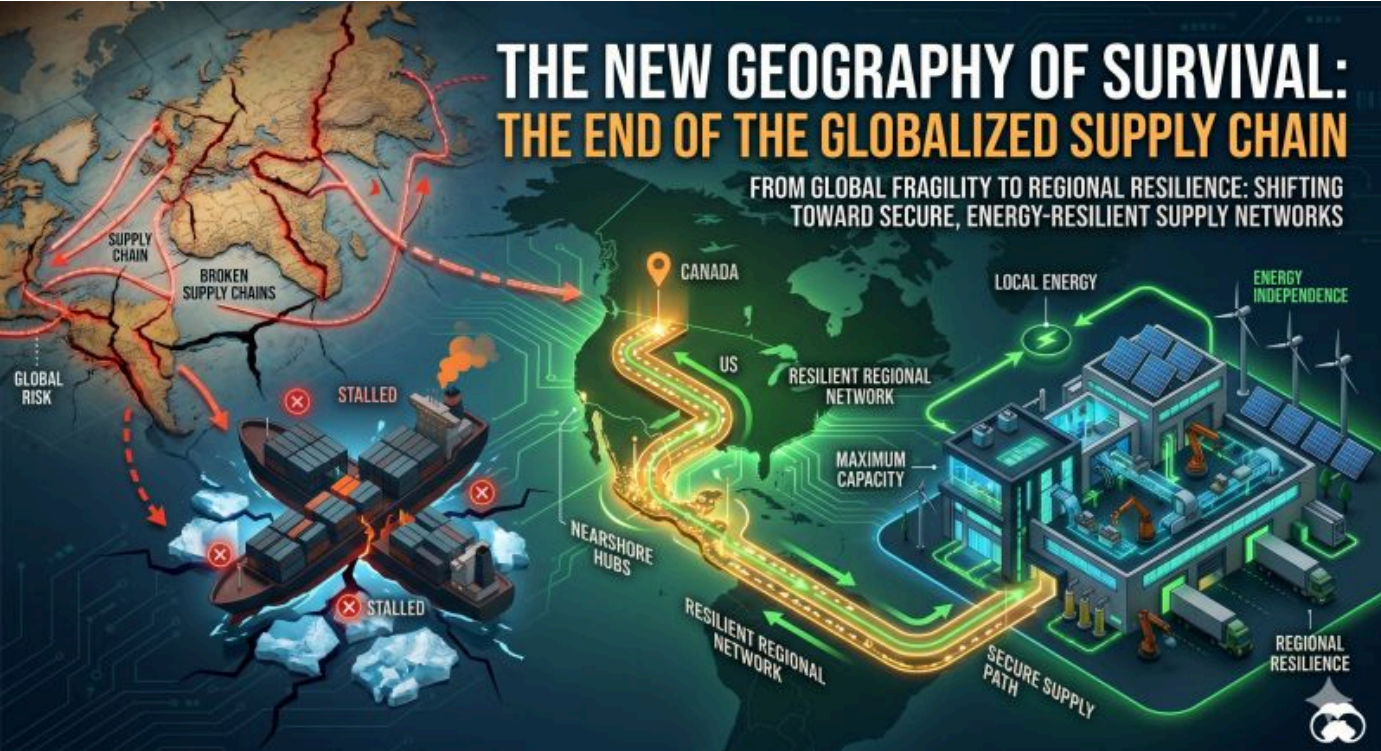
The globalized supply chain was predicated on the illusion of a stable world. That environment has ceased to exist. The de facto closure of the Strait of Hormuz, resulting in a 91 percent collapse in dry bulk transit, serves as a final warning. Decades spent prioritizing the lowest international labor costs have left organizations with profound geographic vulnerabilities. A network engineered solely for cost efficiency cannot withstand the relentless volatility of 2026.
The Analysis:
Industry data confirms a decisive structural reversal. The latest Prologis Supply Chain Outlook indicates that 77 percent of organizations are now actively developing regional, self-sufficient networks.
The fundamental logic of industrial placement has undergone a total transformation. Labor arbitrage is no longer the primary motivator for site selection; energy reliability has now surpassed workforce costs as the decisive factor.
Organizations are actively migrating production to Mexico, Eastern Europe, and emerging Asian hubs.
This shift is not merely an attempt to lower overhead, but a strategic necessity to ensure uninterrupted market access in an increasingly fractured global economy. Theoretical efficiency is an obsolete pursuit. In the current climate, physical resilience and risk mitigation are the only metrics that ensure long-term stability.
The Tactical Step:
Cease evaluating your operational footprint using legacy cost models. The financial premium associated with nearshoring must be viewed as a mandatory investment in survival. Conduct an immediate audit of your supply lines for single-point maritime vulnerabilities. You must secure manufacturing and warehousing capacity within politically aligned hubs now, before competitors exhaust the available infrastructure.
Question for the Network:
Are you restructuring your network around geographic resilience, or are you still holding onto a fragile globalized model?
#SupplyChain #Regionalization #RiskManagement #Geopolitics #OperationalExcellence
References:
Prologis: 2026 Supply Chain Outlook Report ING: Global Trade in 2026 UNCTAD: Hormuz
Shipping Disruptions Report (March 10, 2026)
© 2026 Gnaedinger Consultancy. All rights reserved.
