THE CHALLENGER PROTOCOL: MOVING BEYOND SIMPLE PROMPTS TO ADVANCED PROMPT ENGINEERING
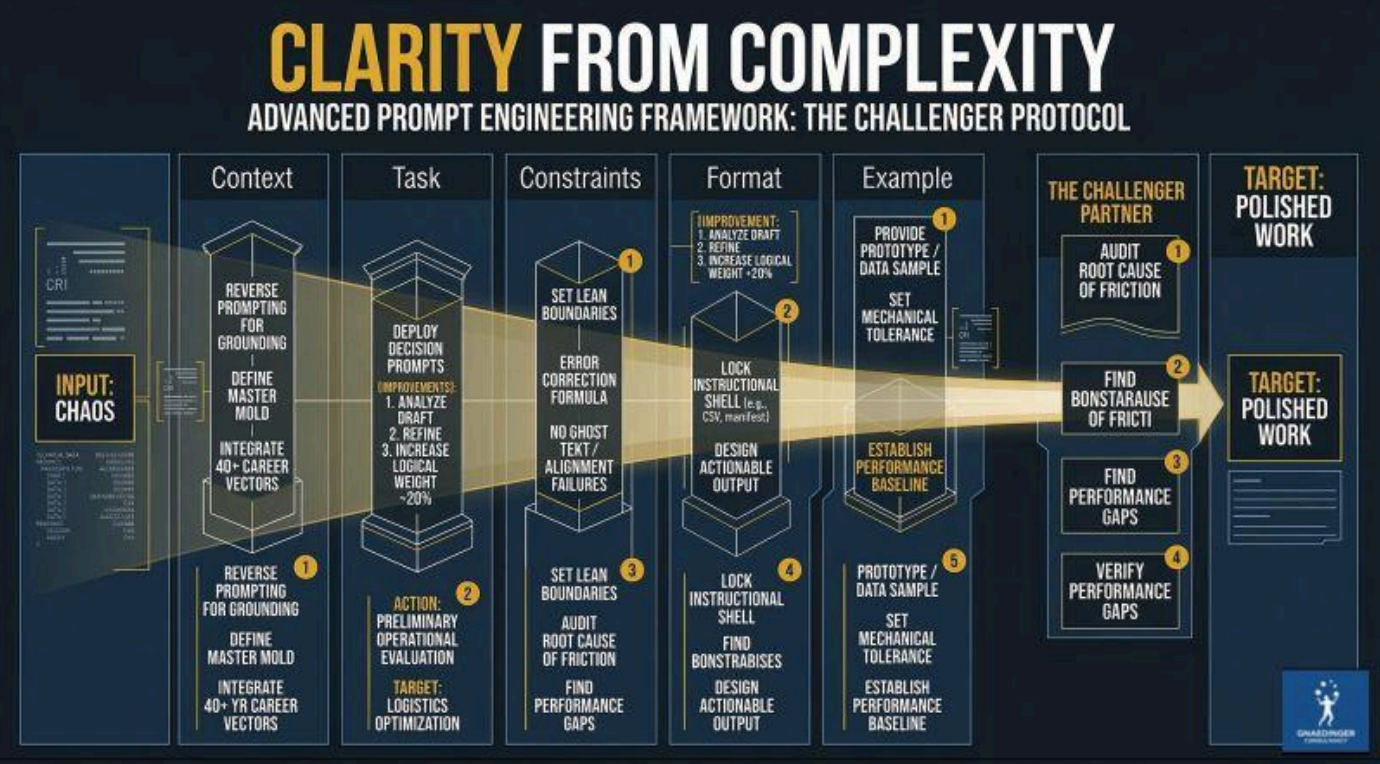
The Challenger Protocol
Generic prompts produce generic results.
In an environment that demands strategic precision and cross-functional execution, there is no tolerance for administrative decay or operational waste. Yet, many organizations are still 'chatting' with their AI engines rather than integrating them into a precise workflow.
We have codified our approach to advanced prompt engineering into a rigorous framework designed to transform raw input (chaos) into polished, actionable work. We call it 'The Challenger Protocol'. This protocol is a five-stage tactical manifest built around mechanical tolerance and continuous logic improvement.
Stage 1: CONTEXT (The Ground Truth)
A project without a defined environment is a ship without a rudder. We apply Reverse Prompting for Grounding to force the system to analyze the history and specific gravity of the data. This defines the Master Mold for all subsequent outputs.
Stage 2: TASK (The Strategic Action)
Before the first gear turns, the target must be locked. We deploy Decision Prompts that instruct the system to rank options by impact versus effort. The AI is not just asked for info; it is asked to execute a Preliminary Operational Evaluation or a Logistics Optimization.
Stage 3: CONSTRAINTS (The Safety Rails)
Discipline is applied by defining absolute lean boundaries. The protocol includes an explicit Error Correction Formula and focuses heavily on Waste Management, systematically identifying root causes of 'Ghost Text' or 'Alignment Failures' (prompt decay) before execution.
Stage 4: FORMAT (The Structural Shell)
Output must be immediately actionable across the organization. We Lock the Instructional Shell (e.g., CSV, manifest, or curriculum structure) and rigorously Verify Cross-Functional Compatibility to ensure the final data integrates perfectly with existing workflows.
Stage 5: EXAMPLE (The Evidence)
A professional standard requires evidence. We feed the machine a Prototype or Data Sample and Set the Mechanical Tolerance for the expected results. This creates an unassailable performance baseline.
The Improvement Cycle: +20% Logical Weight
The protocol includes a continuous improvement cycle that forces iterative drafts: Analyze Draft - Refine Logic - Increase Logical Weight +20%
This methodology takes a simple input and puts it through a high-stakes processor. It is not about saving time; it is about eliminating operational waste and maximizing the value of the AI input.
This is the new standard of tactical execution.
#StrategicExecution #OperationalExcellence #PromptEngineering #TheChallengerProtocol #WasteManagement #AIFrameworks #DigitalTransformation #StrategicManagement
© 2026 Gnaedinger Consultancy. All rights reserved.
