THE AI ENTERPRISE WARS: NAVIGATING OPENAI'S FINANCIAL FRAGILITY AND ENTERPRISE ROI IN 2026
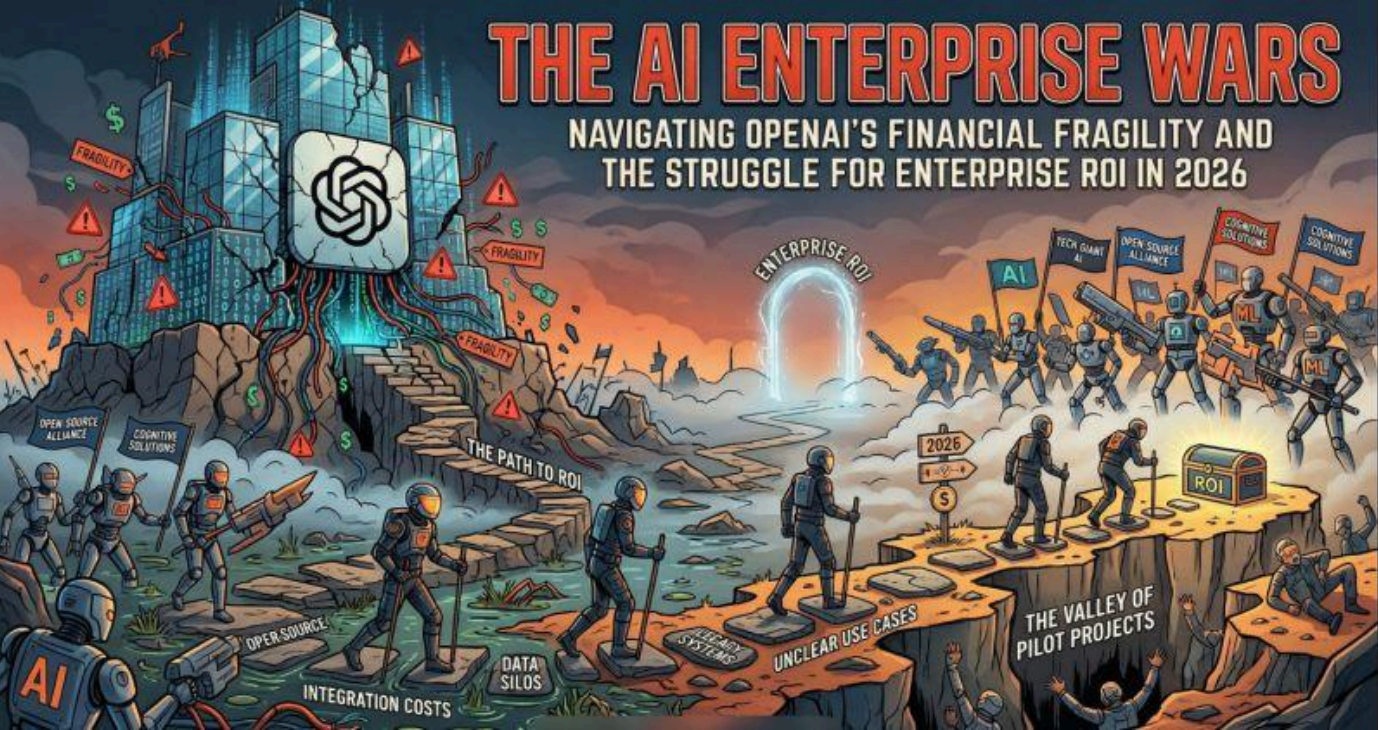
The AI Enterprise Wars
The Observation:
The battle for AI supremacy is no longer just about who has the smartest foundational model, it is about financial sustainability and enterprise workflow integration. OpenAI has restructured into a commercially-driven entity. While raising historic capital, this hyper growth masks an astonishing reality: OpenAI burned through $8 billion in 2025, with internal projections showing operating losses climbing to $14 billion in 2026 and $40 billion by 2028. The fundamental scaling laws of AI dictate that every doubling of intelligence requires roughly five times more compute, energy, and infrastructure.
The Analysis:
Looking under the hood reveals a financial structure that poses a severe risk for the enterprises that rely on it. Much of OpenAI’s Microsoft funding arrives as Azure cloud credits, creating a "financial loop" that cannot cover actual operational expenses like salaries, office rent, or mounting legal bills With training runs for GPT-5 scale models costing over $1 billion each, cumulative losses are projected to hit $143 billion before profitability arrives. Compounding this is an enterprise "double-spending" crisis where a vast majority of companies are paying for multiple redundant AI vendors, creating a massive drain on resources. Unlike competitors with profitable legacy businesses to subsidize AI ambitions, OpenAI lacks a traditional economic moat and relies on a mercenary user base. If venture capital dries up, OpenAI will be forced to stop subsidizing compute costs. For enterprise buyers, this inevitably means API price hikes, slashed enterprise support, or a quiet acquisition by Microsoft at a fraction of its peak valuation.
The Tactical Step:
Business leaders must transition from evaluating isolated foundation models to integrating secure, financially sustainable enterprise workflows. You must evaluate your AI vendor footprint not by who has the most recognizable consumer chatbot, but by whose financial trajectory offers true operational reliability. Stop the dual-spending drain by strategically committing to an ecosystem based on clear operational needs. Establish a contingency strategy for your organization to protect your margins when the era of subsidized AI compute inevitably comes to an end.
Question for the Network:
As the era of subsidized AI compute faces potential financial headwinds, how is your organization mitigating vendor risk? Are you consolidating platforms to stop dual-spending, or still building your infrastructure around cash-burning vendors?
#ArtificialIntelligence #EnterpriseAI #RiskManagement #StrategicManagement #GnaedingerConsultancy
References:
OpenAI’s Transformation: From a Non-profit to a 157 Billion Valuation - Kluwer Law Online OpenAI is
Collapsing In Front Of Our Eyes - Silicon Money
© 2026 Gnaedinger Consultancy. All rights reserved.
