PART 4: THE HOUSE OF CARDS
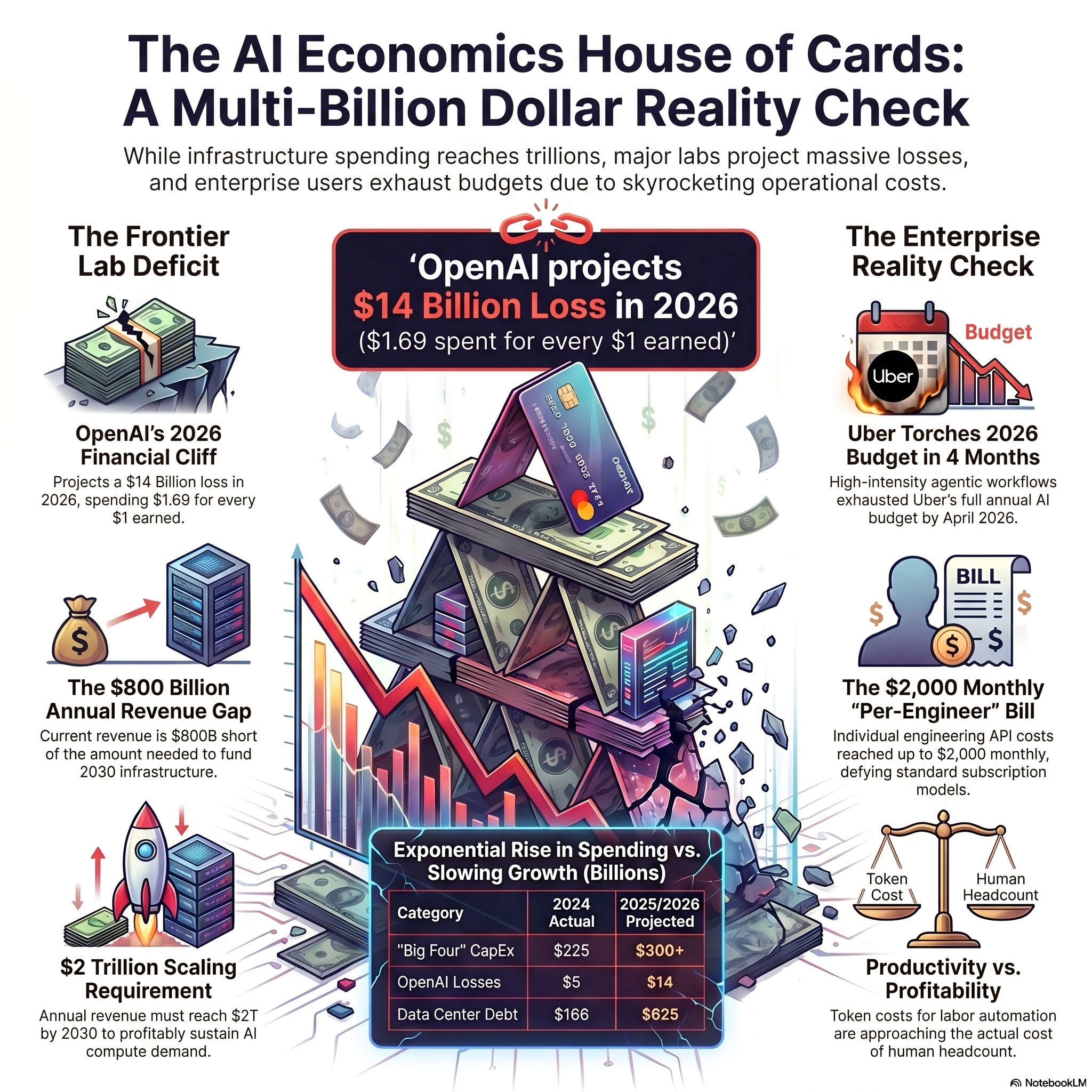
House of Cards
WE HAVE COVERED THE DARK GPU TRAP, THE TOKEN SHOCK, AND THE 95 PERCENT ENTERPRISE FAILURE RATE.
Now, in our final installment, we look at the HOUSE OF CARDS AT THE TOP.
The entire AI ecosystem's valuation is tied to the success of a few labs whose business models are fundamentally unproven and highly fragile.
LOOK AT THE UNDISPUTED LEADER: OPENAI.
According to internal financial documents reported by The Wall Street Journal and The Information, OpenAI projects a staggering $14 billion loss in 2026. Between 2023 and 2028, they expect cumulative losses of $44 billion.
Currently, the company anticipates spending approximately $22 billion this year against roughly $13 billion in sales. That is $1.69 in spending for every single dollar of revenue generated.
OpenAI recently missed its internal targets for user growth and revenue. This sent shockwaves through partners like Oracle and chipmakers like Broadcom.
To survive and bridge this massive gap, OpenAI is quietly shifting its entire business model.
They are now aggressively pivoting to capture $100 billion in digital advertising revenue by 2030. They have already launched a pilot program displaying ads to users on ChatGPT's free and lower-priced tiers.
The AI industry has a reflexivity problem. Valuations drove infrastructure investment, which drove GPU demand, which drove valuations higher. It is a circle, not a foundation.
If the timeline slips even slightly, the financial consequences for the interconnected tech giants will not be a bad quarter. It will be a historic cascade.
(What are your thoughts on this series? Are we headed for a necessary correction, or will the technology grow into its valuation? Share your thoughts below.)
#VENTURECAPITAL #OPENAI #TECHVALUATIONS#MARKETANALYSIS#BUSINESSMODELS#DISRUPTIVETECH
© 2026 GNAEDINGER CONSULTANCY. ALL RIGHTS RESERVED. | NAVI™ IS A PROPRIETARY FRAMEWORK OF GNAEDINGER CONSULTANCY.
