The 2026 Executive Briefing Navigating the NAVI™ World

Navigating the NAVI™ World
Michael Gnaedinger - March 24, 2026
“The impediment to action advances action. What stands in the way becomes the way.”
Marcus Aurelius
Introduction:
Welcome to a comprehensive synthesis of the strategic insights defining the first quarter of 2026. We are currently operating in a NAVI world, which stands for Non linear, Accelerated, Volatile, and Interconnected, where traditional business models have transitioned from a challenge of logistics to a challenge of sovereignty. This newsletter expands on the critical interconnected themes of geopolitical restructuring, the maturation of artificial intelligence, and the human psychology required to execute change.
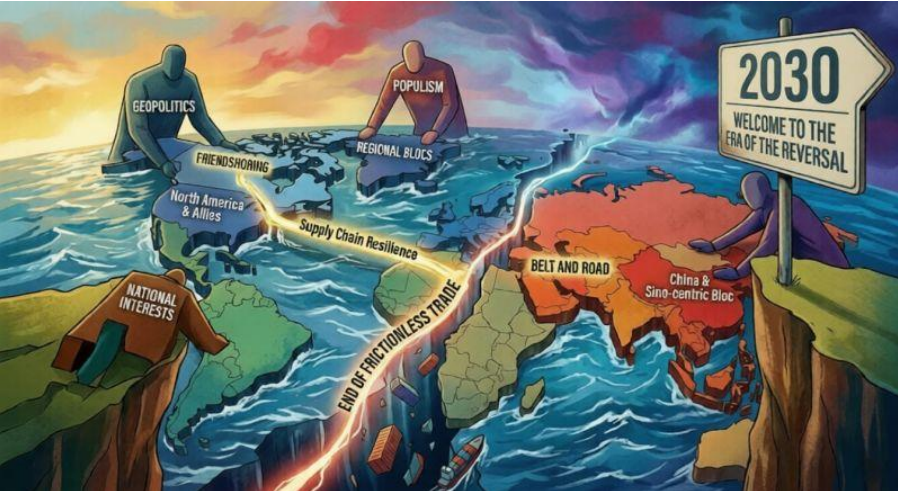
Welcome to The Era of Reversal
Section 1:
The Reversal of Globalization and The Financial Premium of Trust.
The era of chasing the cheapest global labor and relying on frictionless global trade is officially over. Supply chains built purely for theoretical efficiency and calm conditions are collapsing under the pressure of persistent volatility. The March 10th blockade of the Strait of Hormuz, which trapped over 150 tankers and triggered a 91 percent collapse in dry bulk transit, serves as the ultimate proof that extreme disruption is our new baseline. With Brent crude surging past 125 dollars per barrel and maritime insurance premiums seeing a 12 fold increase, we have entered a period of enforced austerity where the financial definition of performance has permanently changed.
Energy reliability is now paramount, with 83 percent of executives viewing it as the next major crisis, as sprawling networks prove highly vulnerable to localized shocks. In this decoupled economy, the return on investment of trust officially outranks the return on investment of scale. Financial leaders must recognize the Financial Premium of Trust, where the premium paid for regionalized manufacturing or secure energy assets is no longer a cost center, but a vital insurance policy against total operational failure. Consequently, 58 percent of business leaders forecast a shift to highly regionalized supply chains by 2030. To navigate peaking global tariffs of around 13 percent and the critical 2026 USMCA review, organizations are aggressively adopting a US Plus One strategy, pivoting toward nearshoring in Mexico to bypass tariff driven demand spikes and protect North American market access.
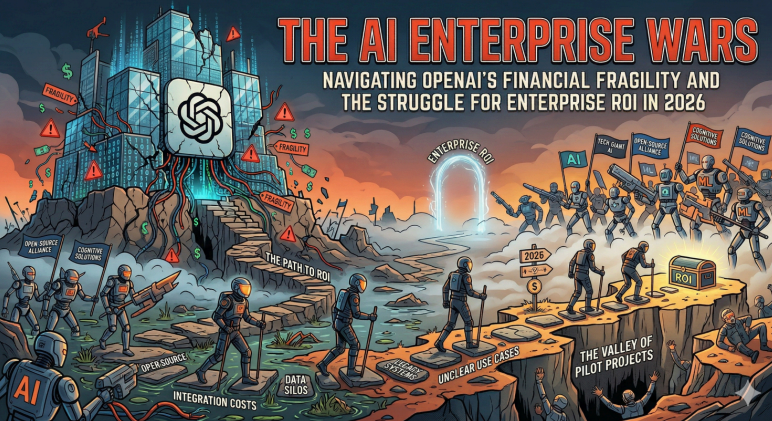
The AI Enterprise Wars
Section 2 The AI Execution Era and Navigating The Enterprise Wars
In 2026, artificial intelligence has definitively shifted from a learning lab of experimentation into the driving force of core business execution, with 75 percent of global supply chain leaders ranking it as their top capital investment priority. Advanced implementations are delivering a 27 percent improvement in operational efficiency and a 23 percent reduction in overall logistics costs. However, enterprise leaders must carefully navigate the AI Enterprise Wars. With OpenAI burning through an estimated 8 billion dollars in 2025 and projecting up to 14 billion dollars in operating losses for 2026, the era of subsidized AI compute is facing severe financial headwinds. To protect margins, organizations must consolidate platforms to stop the massive drain of double spending on redundant vendors and evaluate partners based on long term financial trajectory rather than consumer brand recognition.
When deployed effectively, AI is revolutionizing business through Intelligence Synthesis, compressing hours of analytical labor into minutes using tools like the Navi 2.0 system. Retrieval Augmented Generation acts as the modern Executive Assistant, moving beyond AI hallucinations to pull the exact evidence needed for measured, data driven decisions. To maximize these capabilities, professionals should replace generic chatting with advanced frameworks like The Challenger Protocol. This five stage prompt engineering manifest, which includes Context, Task, Constraints, Format, and Example, forces AI to eliminate operational waste and output strictly polished, cross functionally compatible work. Such precision is also accelerating advanced scientific fields, as AI and predictive modeling are now capable of designing highly selective pharmaceutical drug candidates in just 11 months, significantly reducing the risk of clinical failure.

Illuminating The Blind Spots
Section 3 Redesigning the Network with Nth Tier Visibility and Digital Twins
Supply chains break at the links you cannot see, yet only 60 percent of companies possess full visibility into their tier one suppliers. Achieving Nth tier visibility down to the individual part level is now a critical priority to mitigate single source chokepoints and compliance risks. To build resilient architecture, the supply chain consulting landscape has evolved from generic advisory to simulation driven execution. Organizations are leveraging AI and Digital Twins to create highly detailed virtual replicas of their physical networks, allowing them to continuously stress test against sudden port closures or twenty week supplier failures. In the pharmaceutical sector, these digital twins autonomously detect anomalies to prevent critical drug shortages. Yet, without execution governance, a simulation is merely a high resolution form of fragility. Leaders must utilize decision architecture, like the NAVI Framework, to ensure these digital insights translate into defensible, real world action.
Simultaneously, resilience is being found in the Circular Supply Chain. By shifting from linear take make dispose models to closed loop systems, as seen with Patagonia repairing 100,000 garments or Nike reclaiming end of life footwear, companies can insulate themselves against the volatility of virgin material costs while achieving climate positive goals.
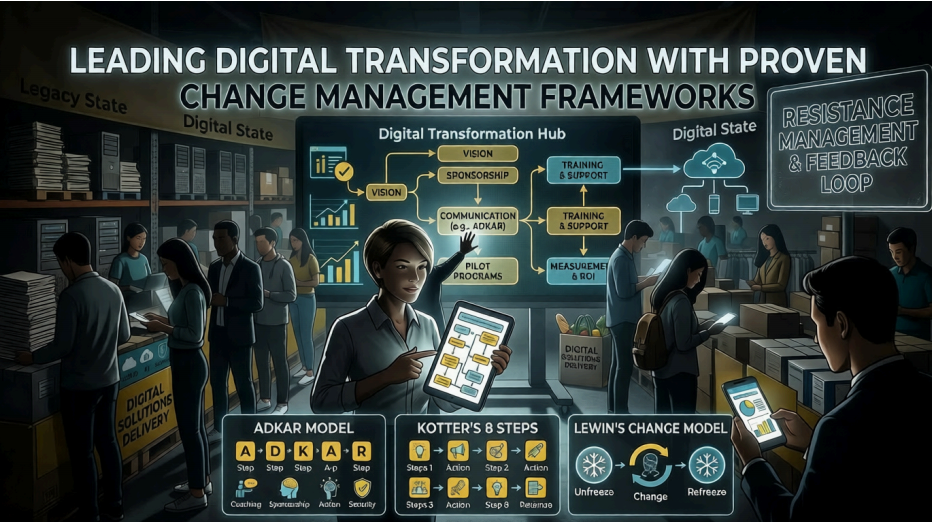
Leading Digital Transformation
Section 4 The Human Element and The Stoic Executive
Technology is accelerating, but human adaptability is the true bottleneck. Change fatigue has become the top execution risk for organizations, with only 41 percent of managers willing to actively sponsor change. Because resistance is rooted in a psychological fear of uncertainty, leaders must use proven organizational change management frameworks, such as the ADKAR model or Lewins Change Model, to prevent change saturation and build trust within human machine teams.
This understanding of psychology must extend to the consumer market and risk management. Inflation has left deep scars, with 47 percent of e commerce shoppers now prioritizing savings over convenience. Brands attempting shrinkflation face massive risks, as 64 percent of consumers view reducing product sizes as an unfair practice and will immediately abandon brands lacking transparency. Furthermore, cyber readiness is no longer an IT delegation but a core operational duty, with the average data breach costing 4.4 million dollars. Leaders must pressure test their capabilities and establish explicit authority for disruptive decisions before a crisis hits.
Finally, in a world where volatility is guaranteed, leaders must adopt the mindset of the Stoic Executive. By practicing Premeditatio Malorum, which is the deliberate rehearsal of setbacks, mapping operational blind spots, and isolating controllable variables, you shift from simply managing a crisis to actively managing your response with discipline.
Question for the Network
As we synthesize these 2026 realities, from the financial premium of trust and the AI enterprise wars to the necessity of change management, which of these structural shifts is currently demanding the most attention from your executive team?
Cited References From The Fortnightly Articles:
Prologis 2026 Supply Chain Outlook Report. Rhenus Seven Global Supply Chain Trends
Shaping 2026. European Journal of Computer Science and Information Technology The
Transformative Impact of Artificial Intelligence on Supply Chain Management 2025 to
2026. Organizational Change Management Trends Report. OCM Solution The
Psychology Of Change Management. Overcoming Resistance In Organizations
International Journal of Environmental Sciences Deloitte 2026. Global Human Capital
Trends ING Global Trade in 2026. Journal of Research in International Business and
Management. Global Supply Chain Resilience UPS 2026. Supply Chain Outlook
Unleashed Software. The Circular Supply Chain Explained Sygnia Executives Guide to
Incident Response Readiness 2026. 2026 Trade Outlook A Herculean Effort KPMG
Economics. 2026 Ecommerce Trends. Navigating Value Seeking Consumers And The
Return Crisis. Artificial Intelligence in pharmaceutical supply chain management A
systemic review. World Journal of Biology Pharmacy and Health Sciences SGR Chain
Resilient Pharma Supply Chains Supply Chain Resilience and Mitigation of Drug
Shortages. Hochschule Worms ADKAR Model. The Guide to Successful Change
Management. SixSigma. Lewins Change Management Model. Understanding the Three
Stages of Change Ohio UNCTAD. Hormuz Shipping Disruptions Report March 10 2026.
Alvarez & Marsal Navigating the 2026 Energy Crisis March 10 2026. Windward Iran War
Maritime Intelligence Daily March 10 2026 Kearney. Structural Forces Push Supply
Chain Costs Up Feb 28 2026. OpenAIs Transformation From a Non profit to a 157 Billion
Valuation Kluwer Law Online. OpenAI is Collapsing In Front Of Our Eyes Silicon Money.
#SupplyChain #Logistics #SupplyChainResilience #Regionalization #EnergyResilience
#Nearshoring #RiskManagement #Geopolitics #ArtificialIntelligence
#SupplyChainInnovation #TechTrends2026 #ChangeManagement #Leadership
#OrganizationalChange #GnaedingerConsultancy #FutureOfTrade
#SupplyChainStrategy #Visibility #CircularEconomy #Sustainability #BusinessStrategy
#RAG #OperationalExcellence #DataAnalysis #AIforBusiness #CyberSecurity #USMCA
#GlobalTrade #StrategicExecution #PromptEngineering #TheChallengerProtocol
#WasteManagement #AIFrameworks #DigitalTransformation #StrategicManagement
#Consulting #Logistics2026 #DigitalTwins #AI2026 #FutureOfWork #DeepResearch
#EnterpriseROI #DecisionIntelligence #DanPrice #Ecommerce #RetailTrends
#ConsumerBehavior #CustomerRetention #DecisionArchitecture #NAVIWorld
#Pharmaceuticals #ADKAR #LewinsModel #StrategicLeadership #StoicLeadership
#SupplyChainCrisis #Geopolitics2026 #FinancialManagement #EnergyCrisis
#SupplyChainFinance #EnterpriseAI
© 2026 Gnaedinger Consultancy. All rights reserved.
NAVI™ is a proprietary framework of Gnaedinger Consultancy
